

Hey there! I'm a supplier of PLC control cabinets, and today I'm gonna talk about the types of actuators that can be controlled by a PLC control cabinet.
First off, let's understand what a PLC control cabinet is. A Programmable Logic Controller (PLC) control cabinet is like the brain of an industrial automation system. It houses the PLC, which is a digital computer specially designed for industrial environments. The PLC can be programmed to perform specific tasks, and it uses input signals to make decisions and send output signals to control various devices, including actuators.
1. Electric Actuators
Electric actuators are one of the most common types of actuators that can be controlled by a PLC control cabinet. These actuators use electricity to generate motion. They come in several forms, such as electric motors and solenoids.
Electric Motors
Electric motors are widely used in industrial applications. They can convert electrical energy into mechanical energy, which can be used to drive conveyor belts, pumps, fans, and other equipment. For example, in a manufacturing plant, a PLC control cabinet can be programmed to start, stop, and adjust the speed of an electric motor based on the production requirements.
The PLC sends signals to the motor control circuit in the control cabinet, which then regulates the power supplied to the motor. This allows for precise control of the motor's operation. If the production line needs to increase the speed of the conveyor belt, the PLC can send a signal to increase the voltage or frequency supplied to the motor, thus increasing its speed.
Solenoids
Solenoids are another type of electric actuator. They consist of a coil of wire and a movable plunger. When an electric current is passed through the coil, it creates a magnetic field that moves the plunger. Solenoids are often used in valves to control the flow of fluids or gases.
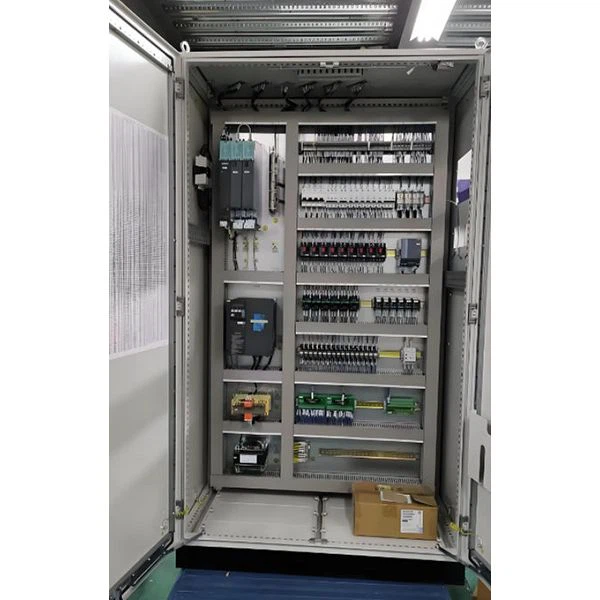

A PLC control cabinet can be used to control the activation and deactivation of solenoids. For instance, in a water treatment plant, the PLC can send signals to open or close solenoid valves based on the water level, pressure, or chemical composition in the tanks. This ensures that the water treatment process runs smoothly and efficiently.
2. Pneumatic Actuators
Pneumatic actuators use compressed air to generate motion. They are known for their simplicity, reliability, and fast response times. Pneumatic actuators are commonly used in applications where high force is required in a short period, such as in automation systems for packaging, assembly, and material handling.
A PLC control cabinet can control pneumatic actuators through solenoid valves. The PLC sends signals to the solenoid valves, which then control the flow of compressed air to the pneumatic actuators. For example, in a packaging machine, the PLC can send signals to the solenoid valves to actuate the pneumatic cylinders that open and close the packaging flaps.
The advantage of using a PLC to control pneumatic actuators is that it allows for precise timing and sequencing of the actuator movements. The PLC can be programmed to ensure that the packaging flaps open and close at the right time, which improves the efficiency and accuracy of the packaging process.
3. Hydraulic Actuators
Hydraulic actuators use hydraulic fluid to generate motion. They are capable of producing very high forces and are often used in heavy-duty applications, such as in construction equipment, industrial presses, and large-scale manufacturing machinery.
A PLC control cabinet can control hydraulic actuators by regulating the flow and pressure of the hydraulic fluid. The PLC sends signals to the hydraulic valves, which control the movement of the hydraulic cylinders or motors. For example, in a metal forming press, the PLC can be programmed to control the force and speed of the hydraulic cylinders based on the type of metal being formed and the desired shape.
The ability to precisely control hydraulic actuators using a PLC is crucial in ensuring the quality and consistency of the manufacturing process. The PLC can adjust the hydraulic pressure and flow rate in real-time, based on the feedback from sensors, to achieve the desired results.
4. Servo Actuators
Servo actuators are a type of electric actuator that can provide precise control of position, velocity, and torque. They are commonly used in applications where high precision and accuracy are required, such as in robotics, CNC machines, and aerospace systems.
A PLC control cabinet can communicate with servo actuators through a servo drive. The PLC sends commands to the servo drive, which then controls the servo motor to achieve the desired position, speed, or torque. For example, in a robotic arm, the PLC can send signals to the servo drives to control the movement of each joint of the arm with high precision.
The use of a PLC to control servo actuators allows for complex and coordinated movements. The PLC can be programmed to perform tasks such as pick-and-place operations, welding, and assembly with high accuracy, which is essential in modern manufacturing and automation.
5. Stepper Actuators
Stepper actuators are also electric actuators, but they operate in discrete steps. They are often used in applications where precise positioning is required, such as in 3D printers, CNC routers, and automated inspection systems.
A PLC control cabinet can control stepper actuators by sending step and direction signals. The PLC determines the number of steps and the direction of rotation of the stepper motor based on the programmed instructions. For example, in a 3D printer, the PLC can send signals to the stepper motors to control the movement of the print head and the build platform, ensuring accurate layer-by-layer printing.
The advantage of using a PLC to control stepper actuators is that it allows for easy programming and adjustment of the actuator's movement. The PLC can be reprogrammed quickly to change the printing pattern or the machining path, which is very useful in small-batch production and prototyping.
The Importance of Choosing the Right PLC Control Cabinet
When it comes to controlling these actuators, choosing the right PLC control cabinet is crucial. Different types of actuators have different power requirements, signal types, and control algorithms. A well-designed PLC control cabinet should be able to provide the appropriate power supply, signal conditioning, and communication interfaces for the actuators.
For example, if you are using high-power electric motors, the control cabinet should have a robust power distribution system and motor protection devices. If you are using servo or stepper actuators, the control cabinet should have high-speed communication interfaces to ensure accurate and timely control.
We offer a variety of PLC control cabinets, including Signal Controller Cabinet, Electrical Control Cabinet, and Industrial Control Cabinet. These cabinets are designed to meet the diverse needs of different industries and applications.
Conclusion
In conclusion, a PLC control cabinet can control a wide range of actuators, including electric, pneumatic, hydraulic, servo, and stepper actuators. Each type of actuator has its own characteristics and applications, and the PLC control cabinet plays a vital role in ensuring their efficient and precise operation.
If you are looking for a reliable PLC control cabinet for your actuator control needs, we are here to help. Our team of experts can provide you with professional advice and customized solutions to meet your specific requirements. Whether you are in the manufacturing, automation, or any other industry, we can offer the right control cabinet for your application. Contact us today to start the procurement negotiation and take your automation system to the next level!
References
- "Industrial Automation Handbook"
- "Practical Guide to PLC Programming"
- "Actuators in Modern Manufacturing"